

The Montessori Children’s House Primary program is for children aged three to six. This is a mixed-aged environment, keeping with Dr. Montessori’s belief that children learn from other children. The three age groups are referred to as Primary 1 (first-year students), Primary 2 (second-year students), and Primary 3 (third-year students of kindergarten age). All three groups work together in one classroom.
All Montessori Children’s House teachers are formally trained to recognize windows of learning (known in Montessori as sensitive periods) that occur in young children. The teachers lead the child to specific materials when most appropriate to maximize the child’s developmental growth.
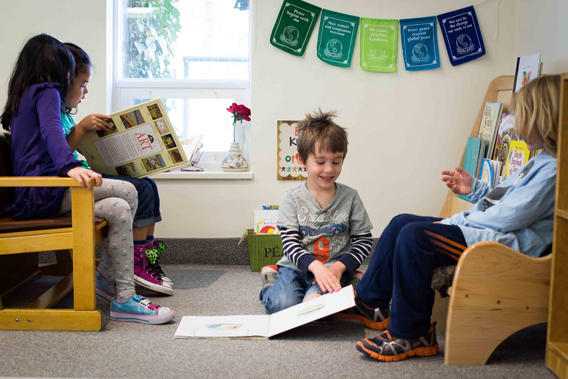
The Primary classroom is comprised of these five areas:
Practical Life
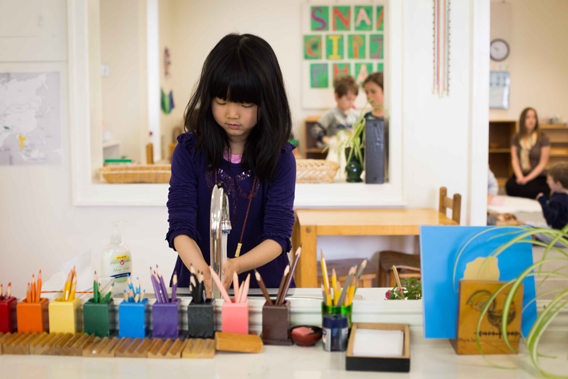
Our Practical Life work helps a child to gain a strong sense of order. Each Practical Life material is designed to foster a child’s ability to concentrate and build fine and gross motor coordination. Lessons are presented and arranged from left to right, top to bottom, in preparation for reading and writing.
Students find true citizenship within our classroom, for they learn to care about the classroom environment by watering plants and putting their own materials away. Through Practical Life work, children learn to dress themselves, set out their snacks, and tie their own shoelaces, thus providing the basis for independence at the Primary level.
Sensorial
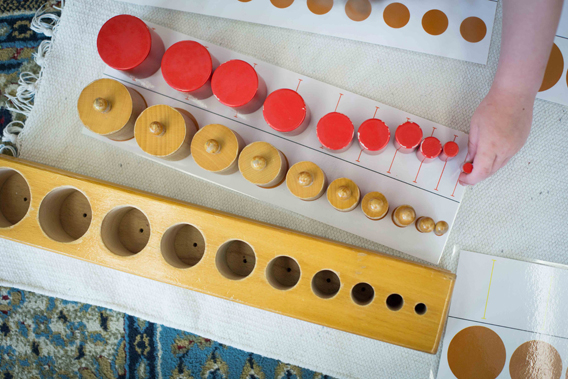
Sensorial work increases a child’s ability to observe, compare, differentiate, reason, decide, solve problems, and all around appreciate the world at large. Materials provide children with a system, through which each child can form a basis for order and logic. The experience of order is gained through observing, touching, sorting and categorizing these Sensorial materials.
Work within the Sensorial area ranges from the Pink Tower (learning to grade by size) to more advanced work like the Trinomial Cube, a three-dimensional puzzle representing the equation (a+b+c)3.
Language
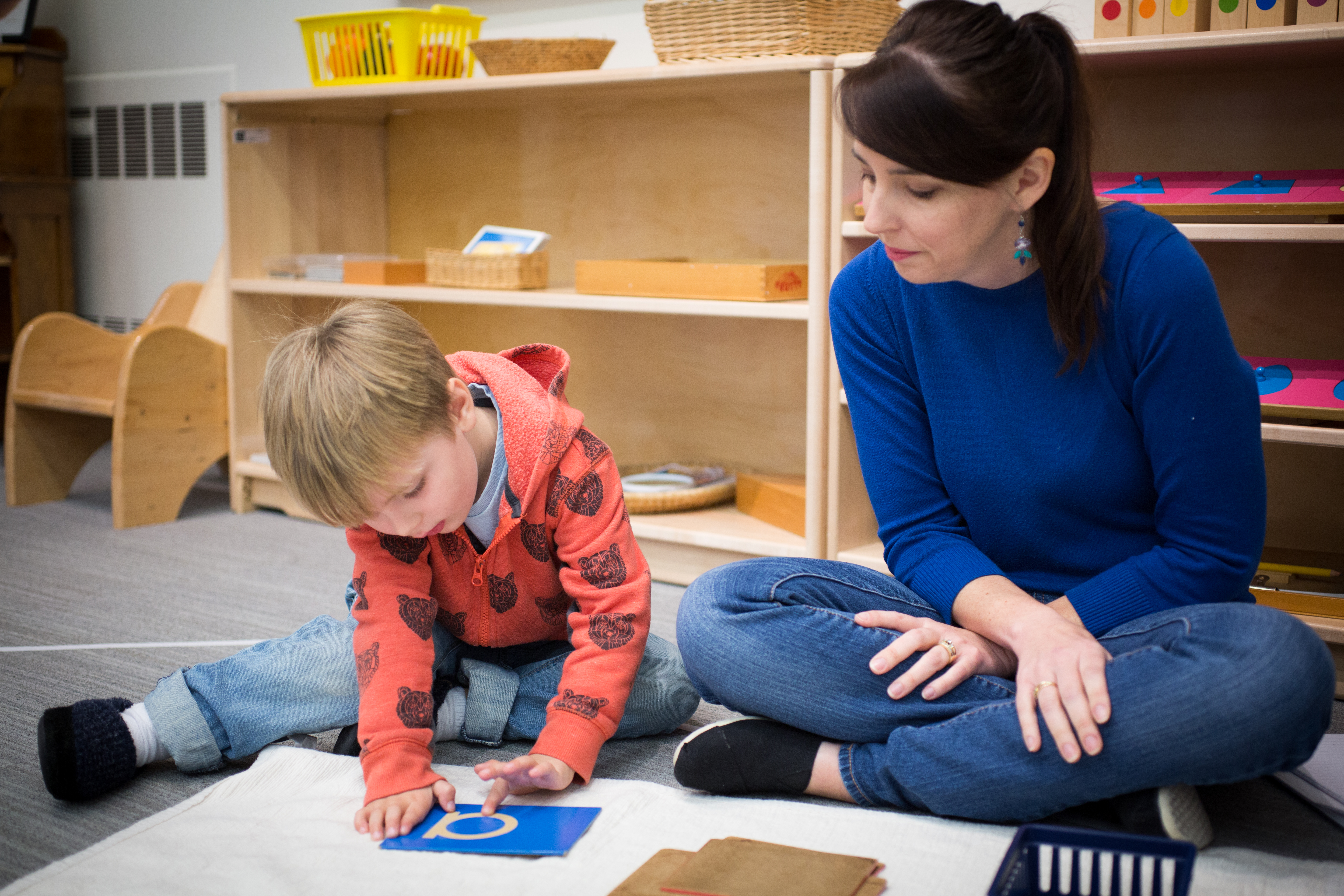
Capitalizing on how the classroom environment flows with speech and vocabulary, Language work is designed to help children with listening, reading, and writing skills. Children begin with exposure to pre-reading work, such as sound games, rhyming, and synonym / antonym concepts. Students then learn letter sounds while tracing the Sandpaper Letters, which reinforces fine motor skills needed for writing. As the lessons progress, children blend words while simultaneously learning to spell phonetically.
Work within the Language area ranges from listening to a story to reading and writing at a paragraph level. Older students have a chance to journal and experience formal handwriting lessons.
Math
With Math work, children are introduced to concrete counting concepts and numeral recognition at a young age. The unique Montessori math materials provide a solid foundation to introduce math concepts. The children begin associating numeral symbols with quantities, and continue on to work with the decimal system. The didactic materials are used to illustrate how numbers can be manipulated through the math operations.
Cultural Studies
Through the exploration of nature, people, and geography of each continent, children learn to appreciate cultures and the needs of others. Cultural Studies work introduces children to the concept of places and times around the world, by working with globes, puzzle maps, flags, and integrated animal study. Basic classification skills and nomenclature are learned through scientific lessons drawing on botany, biology, science and zoology. An early emphasis on cultural studies and peace education is a guiding principle of the Montessori Philosophy.